How do maglev trains float, and what pushes them forward?
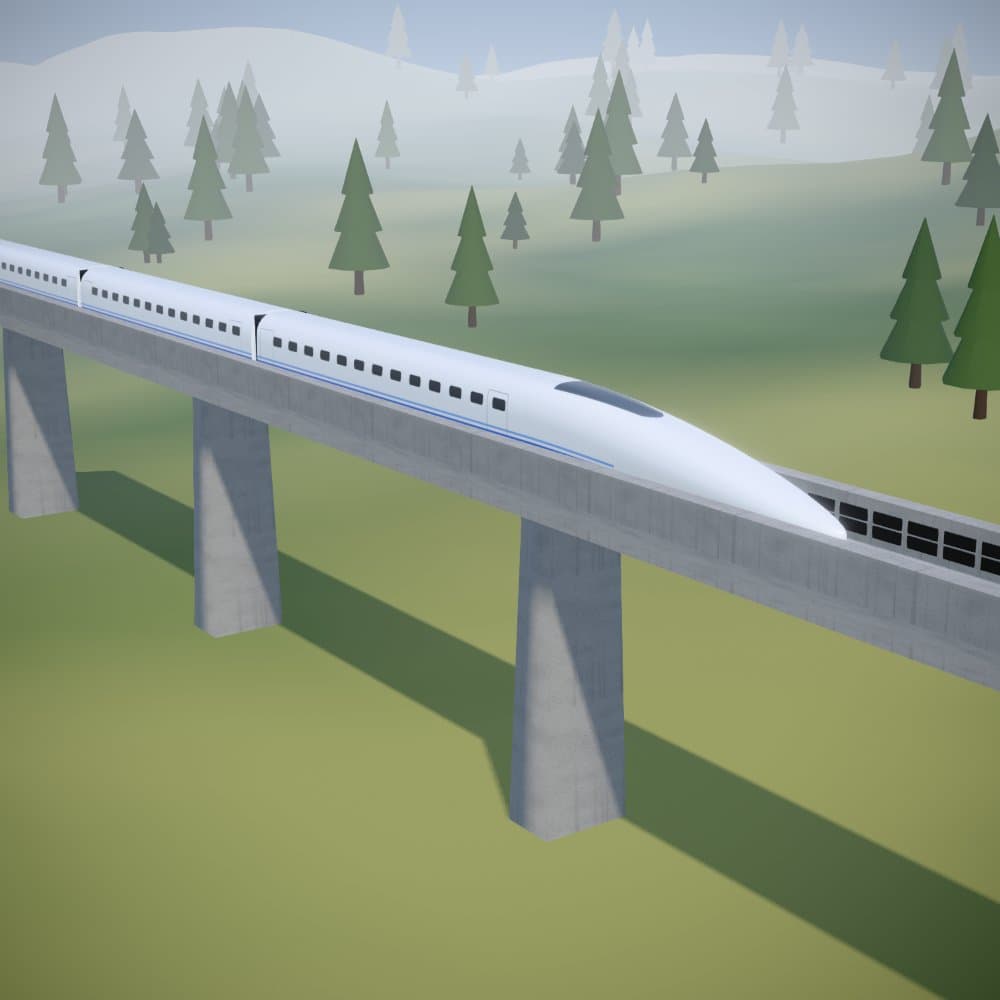
A train is heavy. A fridge magnet is not. So seeing a train float above its track raises a reasonable question: how do magnets manage that much weight?
There's a second question that's easy to miss. Even if magnets hold the train up, what makes it go forward? Lifting and moving are different jobs, and a maglev system has to do both.
Start with the push you can feel
Hold two magnets near each other. Depending on which ends face, they pull together or push apart. Their ends are called poles: north and south. Matching poles repel, while opposite poles attract.
That force crosses a gap. The magnets don't need to touch. A magnetic field is how we describe this influence in the space around them. A maglev train uses that ability to exert a force without contact, but at a much larger scale.
Electricity and magnetism are connected. Send an electric current, a flow of electric charge, through a coil of wire and it acts like a magnet. Change the current and you can change its magnetic effect. This gives engineers something more controllable than a pile of fridge magnets.
Not every maglev train floats in the same way
Maglev is short for magnetic levitation. It names the outcome, not one single design. Some systems use controlled electromagnets to pull the train towards the guideway. Sensors and rapid adjustments keep the gap from closing.
Japan's superconducting maglev uses a different arrangement. Powerful magnets on the train interact with coils along the sides of a U-shaped guideway, the special track structure the train runs through.
Here we're following that Japanese design, the same one shown in our interactive explainer. Keeping the design specific matters: a detail that's true for one maglev system isn't automatically true for every other one.
Why make the magnets so cold?
An ordinary wire resists an electric current. Some electrical energy ends up as heat, which is why a powerful electromagnet can need considerable power just to keep working.
Certain materials, cooled below a particular temperature, enter a state called superconductivity. Their electrical resistance disappears. A suitably designed loop can carry a persistent current, producing a strong magnetic field without the usual continuous resistance losses in the wire.
The train's superconducting magnets need cooling equipment to maintain those conditions. Superconductivity doesn't make the whole train free to run: refrigeration, propulsion, and other onboard systems still need energy. It makes one important part of the magnetic system possible.
Moving magnets make the track respond
As the train's magnets pass the guideway's levitation coils, the magnetic field through those coils changes. A changing field can produce an electric current in a loop of wire. That process is called induction.
The induced current makes the guideway coils magnetic too. The arrangement of the coils creates forces that support the passing train. JR Central describes a levitation gap of about 10 centimetres: enough to float, but not a train flying freely through the sky.
The coil arrangement also helps keep the train centred. A sideways shift changes how its magnets interact with the coils on either side, producing a restoring force. At low speeds, the lift isn't sufficient, so this system uses wheels until it is moving fast enough to levitate.
Forward motion comes from a moving magnetic pattern
Levitation removes wheel contact at speed, but it doesn't automatically move the train. For that, another set of coils in the guideway receives electrical power.
Their magnetic poles change in a timed sequence. The resulting pattern moves along the guideway, pulling the train's magnets towards poles ahead and pushing them away from poles behind. Adjusting how quickly the pattern changes controls its travelling speed.
It's a motor stretched out along the route instead of a motor turning a wheel. The train still has to push through air, and air resistance becomes a big deal at high speed. Floating removes one source of resistance, not every source.
The idea to take with you
Three jobs make the ride possible: magnets and guideway coils provide lift, their arrangement keeps the train centred, and powered propulsion coils move the magnetic pattern forward.
Sources and further reading
These explanations draw on the references below. Analogies help picture the mechanism; they aren't literal descriptions of the hardware.
- JR Central: the superconducting maglev mechanismSuperconducting magnets, levitation and guidance coils, the approximately 10 cm gap, and timed propulsion poles.