Nuclear fusion vs fission: what's actually different?
Fusion joins things. Fission splits them. That's the explanation most of us remember, and it's a useful start. But it leaves out the strange part: how can opposite processes both release energy?
To answer that, we need to look inside an atom. Not with a long equation or a page of unfamiliar symbols. Just far enough to see what's being rearranged, and why a tiny rearrangement can matter so much.
The action happens in the nucleus
An atom is a tiny unit of matter. At its centre is a much smaller nucleus, which contains positively charged protons and, in most atoms, neutrons with no electric charge. Negatively charged electrons occupy the space around it.
Chemical reactions rearrange how atoms share or transfer electrons. Burning gas on a stove is an example. Nuclear reactions change the nuclei themselves, which involves a different and much larger energy scale.
So 'nuclear' doesn't mean a particular kind of machine. It tells us which part of the atom is involved. A nuclear reaction can happen in a reactor, in a laboratory, or inside a star.
Fission breaks a heavy nucleus
In a typical fission reactor, a neutron enters a suitable heavy nucleus, such as uranium-235. The nucleus can split into smaller nuclei, releasing energy and more neutrons.
Those new neutrons can trigger further splits. This is a chain reaction. A power reactor is designed to control it, using materials and systems that manage how many neutrons go on to cause another fission.
Much of the released energy becomes heat as the fast-moving pieces interact with surrounding material. In many plants, that heat makes steam, which turns a turbine connected to a generator. The nuclear part is the heat source; much of the electricity-making machinery is recognisable power-station engineering.
Fusion brings light nuclei together
Fusion goes the other way: light nuclei combine. Many experimental fusion designs use deuterium and tritium, two forms of hydrogen. Each has one proton, but deuterium has one neutron and tritium has two.
When these nuclei fuse, they produce a helium nucleus and a fast neutron, releasing energy. That isn't exactly the same reaction chain as the Sun's. The Sun mainly turns ordinary hydrogen into helium through a sequence of reactions.
The hard part is bringing the starting nuclei close enough. Both are positively charged, so they repel each other. Very high temperatures make them move faster, increasing the chance of encounters close enough for the short-range nuclear attraction to take over.
Why can joining and splitting both release energy?
The answer isn't 'breaking things always releases energy' or 'joining things always releases energy'. What matters is whether the final nuclei are more tightly bound than the starting ones.
For suitable light nuclei, joining can move them towards a more tightly bound arrangement. For suitable very heavy nuclei, splitting can do the same. It's like reaching a lower valley from opposite sides of a hill: the directions differ, but both journeys can go downhill.
The products have a little less mass than the starting ingredients, when all the products are counted. That difference appears as released energy. Mass and energy are connected, and even a small mass difference can correspond to a large amount of energy. This explanation applies to suitable reactions, not every imaginable split or combination.
The Sun has an advantage we can't build into a room
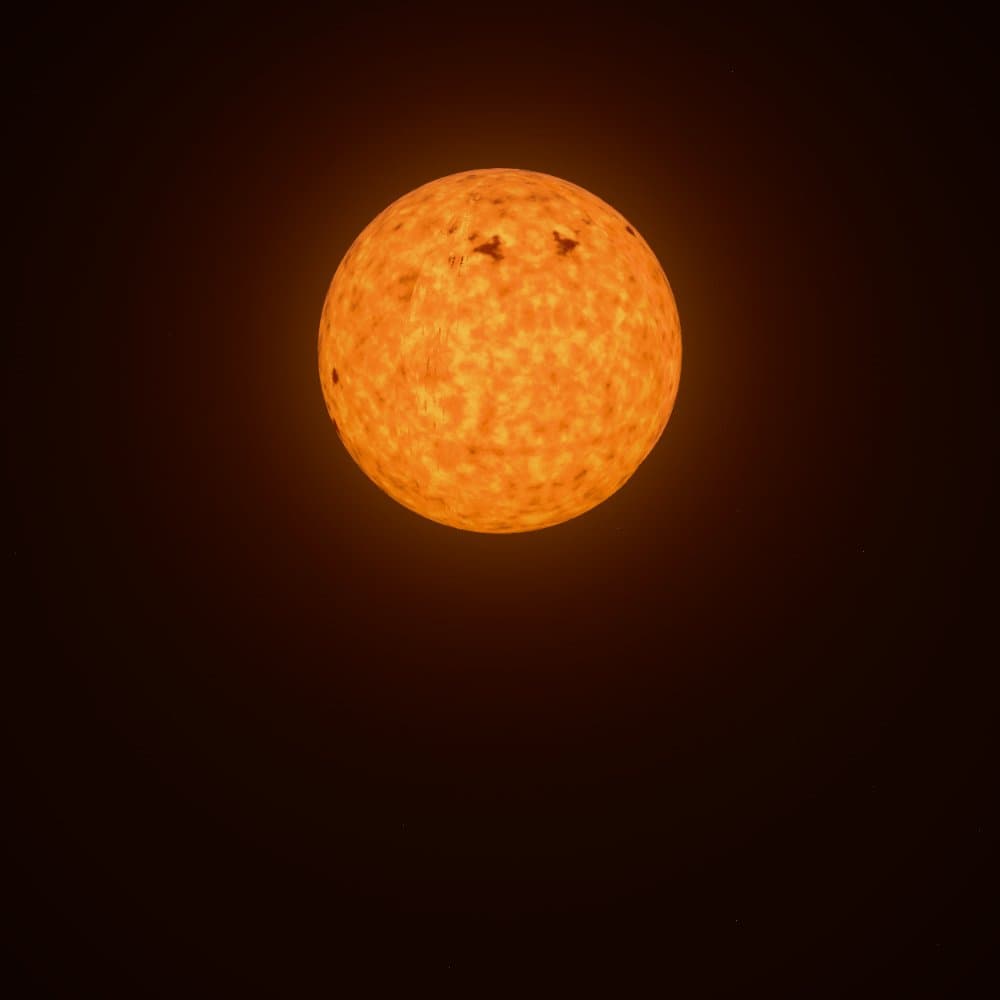
The Sun's enormous gravity holds its fuel under extreme pressure. Its core is around 15 million degrees Celsius. It has the temperature, density, and confinement needed to keep fusion going.
An Earth-based experiment can't borrow the Sun's gravity. It needs another way to keep the fuel together. At fusion temperatures, the fuel is plasma: a gas in which electrons have been separated from nuclei, leaving electrically charged particles.
A tokamak uses magnetic fields to help confine that plasma in a ring-shaped chamber. Other experiments use powerful lasers to compress a tiny fuel target. These approaches solve the confinement problem differently; neither is simply a miniature Sun in a jar.
A fusion result isn't automatically a working power station
When you read about an energy-gain milestone, ask where the energy was measured. Comparing fusion energy with energy delivered to the fuel is different from comparing electricity exported by a whole facility with electricity drawn from the grid.
A useful power station also needs reliable operation, heat collection, electricity generation, suitable materials, and a workable fuel supply. Deuterium-tritium fusion produces neutrons that challenge materials, and tritium has to be carefully managed.
Fusion is worth understanding without treating every milestone as the finish line. Fission's controlled chain reaction and fusion's demanding fuel conditions are different engineering problems. Neither can be judged sensibly from the word 'nuclear' alone.
The idea to take with you
Fusion and fission aren't opposites in their energy outcome. Both can release energy by rearranging nuclei into more tightly bound forms. Their starting fuel, reaction conditions, and engineering challenges are very different.
Sources and further reading
These explanations draw on the references below. Analogies help picture the mechanism; they aren't literal descriptions of the hardware.
- IAEA: what is nuclear fusion?Fusion, plasma, electrical repulsion, confinement, and the role of gravity in stars.
- ITER: what is fusion?The Sun's core temperature and the connection between mass difference and released energy.
- IAEA: the science of nuclear powerNuclear fission, uranium fuel, chain reactions, and electricity production.